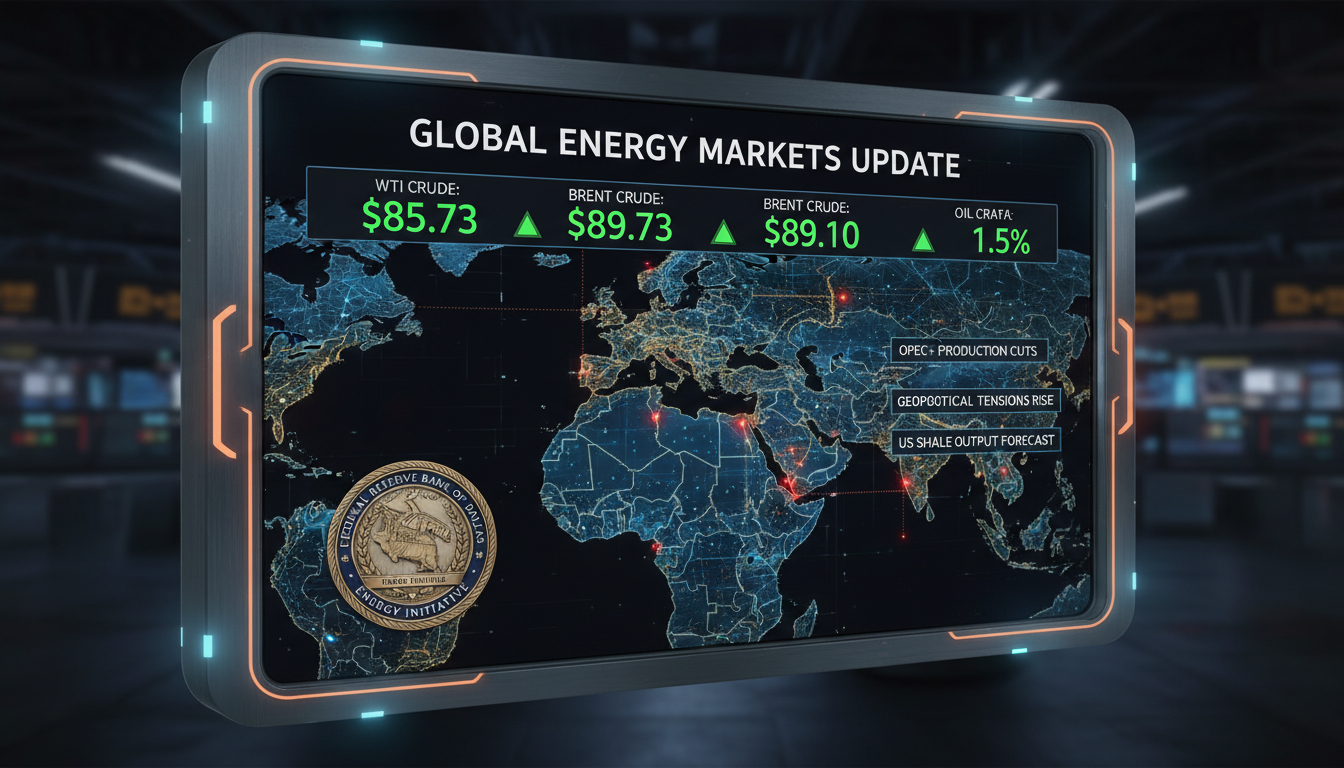
The Federal Reserve Bank of Dallas has released a rare mid-quarter update to its Q1 2026 Energy Survey, painting a picture of an industry grappling with unprecedented volatility. Driven primarily by the escalating military conflict involving Iran and the subsequent closure of maritime chokepoints, the report signals a fundamental shift in how U.S. shale operators value risk and allocate capital.
Key Takeaways
- Uncertainty Index Peaks: The aggregate business uncertainty index surged to a record 53.7, reflecting the industry's inability to forecast long-term price stability.
- The "Geopolitical Premium": Executives expect a permanent increase of $2–$4 per barrel in logistics, insurance, and freight costs even after the current conflict subsides.
- Strait of Hormuz Timeline: 39% of energy executives do not expect maritime traffic to normalize until at least August 2026, with 26% looking toward November.
- Modest U.S. Response: Despite WTI prices holding above $75, 70% of respondents expect 2026 production gains to remain modest, likely under 250,000 bpd.
Geopolitical Risk Becomes the Primary Driver
For years, the Dallas Fed Energy Survey focused on domestic regulatory hurdles, such as methane fees or federal leasing pauses. The April 2026 update, however, marks a transition to a "geopolitical-risk-first" era. Lead economists Michael Plante and Kunal Patel noted that the military conflict involving Iran is now the singular driver of market gyrations, overshadowing traditional supply-demand fundamentals.
E&P firms (Exploration & Production) are currently navigating a significant gap between "paper" market prices, which are highly reactive to headlines, and the "physical" market, where infrastructure damage and shipping delays are creating localized shortages. While small operators are adding rigs to capitalize on $75+ WTI, many remain vulnerable to a "price cliff" should de-escalation occur more rapidly than anticipated.
The Fragility of the Global Supply Chain
A recurring theme in the executive comments is the vulnerability of the Strait of Hormuz. Nearly 50% of the surveyed executives view future disruptions in this region as "very likely" within the next five years. This sentiment suggests that the industry is no longer viewing the current crisis as a one-off event but rather as a permanent feature of the modern energy landscape. For oilfield services (OFS) firms, this has led to increased demand from smaller operators, yet infrastructure and logistical uncertainty remain significant hurdles to scaling operations.
Trust Block
Well Watch provides independent analysis for accredited investors in the energy sector. This report is based on the April 2026 data update provided by the Federal Reserve Bank of Dallas. We do not accept compensation from the entities mentioned in this report.
Source Block
Primary Source: Federal Reserve Bank of Dallas, Energy Survey Update (April 2026).
Data Points: Michael Plante & Kunal Patel, Dallas Fed Economists.
Internal Reference: Analysis of U.S. Shale Breakeven Costs